Selecting the correct fiber laser power is the most critical decision when buying a laser cutting machine. This comprehensive guide matches laser wattage to material type, thickness, and production volume to help you invest wisely.
# How to Choose the Right Fiber Laser Power: 3kW, 6kW, 12kW, or 20kW?
Investing in a fiber laser cutting machine is one of the most transformative decisions a metal fabrication shop can make. The global laser cutting machine market is experiencing an impressive 8.4% CAGR, driven by the complete dominance of fiber laser technology over legacy CO2 systems. Fiber lasers offer unparalleled cutting speeds, lower operating costs, and minimal maintenance.
However, the most common—and arguably the most critical—question buyers face is: "How much laser power do I actually need?"
Choosing too little power limits your cutting capacity and slows down production, leaving you uncompetitive. Conversely, over-investing in a 20kW system when your shop primarily processes thin sheet metal ties up valuable capital with no measurable return on investment.
This comprehensive guide breaks down the capabilities of different fiber laser power levels—from 3kW to 20kW and beyond—helping you match the right wattage to your specific material types, thicknesses, and production goals.
The Relationship Between Laser Power, Speed, and Thickness
Before diving into specific power tiers, it is essential to understand the physics of fiber laser cutting. Laser power (measured in kilowatts, kW) directly determines two factors:
- •Maximum Piercing and Cutting Thickness: Higher power allows the beam to melt through thicker plates of carbon steel, stainless steel, and aluminum.
- •Cutting Speed: On thinner materials, higher power translates to significantly faster cutting speeds. A 6kW laser will cut 3mm carbon steel much faster than a 3kW laser.
However, the relationship is not entirely linear. Doubling the laser power does not necessarily double the cutting speed across all thicknesses, nor does it double the maximum thickness capacity. The optimal choice depends heavily on your shop's "sweet spot"—the material thickness that makes up 70-80% of your daily production volume.
Power Selection Guide: Matching Wattage to Workload
1.5kW to 3kW: The Entry-Level Workhorse
Best for: Light-gauge fabrication, HVAC ductwork, signage, and precision electronics enclosures.
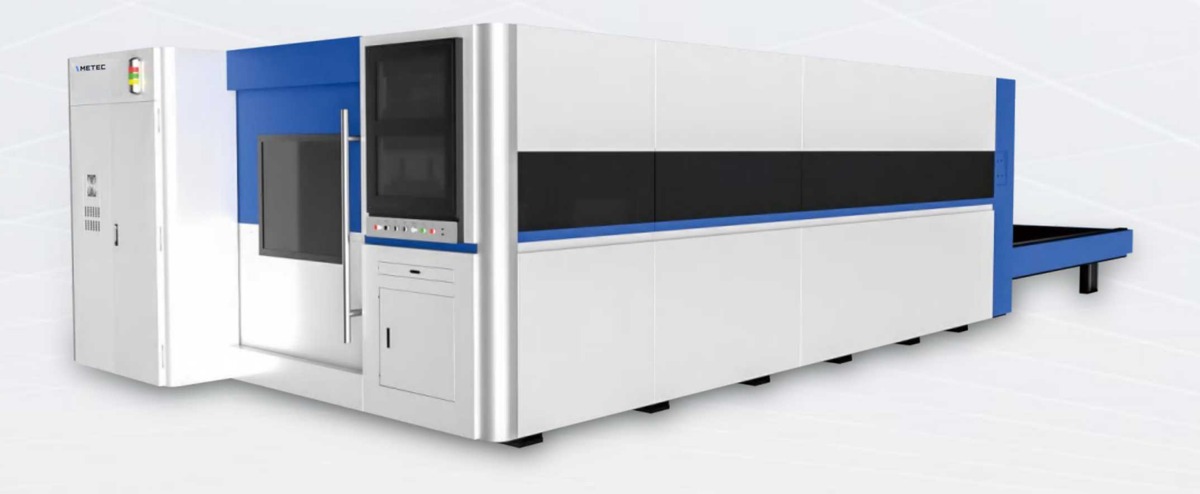
A 3kW fiber laser, such as the entry-level models in the [Metec MLS Series Single Table Fiber Laser](/products/sheet-metal-laser/mls-series), is the perfect replacement for an aging CNC punch press or plasma cutter. It is highly economical and excels at cutting thin materials rapidly.
- Carbon Steel: Excellent up to 10mm; maximum capacity around 16mm (edge quality decreases near the limit).
- Stainless Steel: Excellent up to 5mm; maximum capacity around 8mm.
- Aluminum: Excellent up to 4mm; maximum capacity around 8mm.
The Verdict: If your shop rarely processes material thicker than 1/4 inch (6mm), a 3kW machine offers the fastest ROI and lowest operating cost.
4kW to 6kW: The High-Mix Sweet Spot
Best for: General job shops, OEM manufacturers, and medium-gauge structural fabrication.
The 6kW power tier is currently the most popular choice for general fabricators. It provides the perfect balance between speed on thin sheets and the capability to process medium plate when required. A 6kW system on a [Metec MLSD Series Exchange Table Laser](/products/sheet-metal-laser/mlsd-series) can dramatically increase shop throughput.
- Carbon Steel: Excellent up to 16mm; maximum capacity around 22mm.
- Stainless Steel: Excellent up to 10mm; maximum capacity around 16mm.
- Aluminum: Excellent up to 10mm; maximum capacity around 16mm.
The Verdict: If your production mix is unpredictable and you need the versatility to cut 20-gauge sheet in the morning and 1/2-inch plate in the afternoon, 6kW is the ideal investment.
10kW to 12kW: The Heavy-Duty Standard
Best for: Heavy equipment manufacturing, agricultural machinery, and high-volume service centers.
Stepping up to 12kW transitions a shop from general fabrication into heavy industrial processing. At this power level, the laser cuts through 10mm to 16mm plate with astonishing speed and leaves a clean, dross-free edge that rarely requires secondary grinding.
- Carbon Steel: Excellent up to 25mm; maximum capacity around 35mm.
- Stainless Steel: Excellent up to 20mm; maximum capacity around 30mm.
- Aluminum: Excellent up to 20mm; maximum capacity around 30mm.
The Verdict: A 12kW machine is designed for shops where 1/2-inch to 1-inch plate constitutes the majority of the workload. The speed increase on medium-thick plate justifies the higher capital expenditure.
20kW to 30kW+: The Ultra-High-Power Frontier
Best for: Shipyards, aerospace, defense, and specialized heavy plate processing centers.
Ultra-high-power fiber lasers (20kW, 30kW, and beyond) are reshaping heavy industry. Historically, cutting 30mm to 50mm plate required plasma or waterjet cutting, which leaves a wide kerf, a significant heat-affected zone (HAZ), and a tapered edge. A 30kW fiber laser, such as the [Metec MLG Series Large Format Laser](/products/sheet-metal-laser/mlg-series), can cut 40mm carbon steel with a perfectly vertical edge, eliminating hours of secondary machining.
- Carbon Steel: Excellent up to 40mm; maximum capacity 50mm+.
- Stainless Steel: Excellent up to 40mm; maximum capacity 50mm+.
- Aluminum: Excellent up to 40mm; maximum capacity 50mm+.
The Verdict: Invest in ultra-high power only if you are competing in the heavy plate market and need to replace plasma/waterjet systems with high-precision laser cutting.
Comprehensive Power vs. Material Reference Table
The following table provides a practical reference for matching laser power to material type and thickness. Cutting speeds are approximate and vary based on assist gas, nozzle size, and machine quality.
| Laser Power | Carbon Steel (Excellent) | Stainless Steel (Excellent) | Aluminum (Excellent) | Typical Application |
| :--- | :--- | :--- | :--- | :--- |
| 3kW | Up to 10mm | Up to 5mm | Up to 4mm | HVAC, signage, electronics |
| 6kW | Up to 16mm | Up to 10mm | Up to 10mm | General job shop, OEM |
| 12kW | Up to 25mm | Up to 20mm | Up to 20mm | Heavy equipment, structural |
| 20kW | Up to 35mm | Up to 35mm | Up to 35mm | Shipbuilding, heavy plate |
| 30kW+ | Up to 50mm+ | Up to 50mm+ | Up to 50mm+ | Aerospace, defense, heavy industry |
Note: Maximum cutting thickness (edge quality decreases near the limit) extends approximately 30-50% beyond the "excellent" range for each power level.
Key Factors Beyond Laser Power
Selecting the right wattage is only the first step. To ensure a profitable investment, buyers must evaluate the complete machine ecosystem:
1. Automation and Material Handling
A 12kW laser cuts incredibly fast. If you pair a high-power laser with a manual loading system, the machine will spend 60% of its time waiting for the operator to clear parts and load the next sheet. For lasers 6kW and above, an automated exchange table (pallet changer) is mandatory to maximize spindle time.
2. Assist Gas Management
Higher power allows you to cut thicker stainless steel and aluminum using Nitrogen assist gas. Nitrogen cutting prevents oxidation, leaving a clean, bright edge ready for welding or painting. However, high-pressure Nitrogen consumption can be expensive. Ensure your machine features an optimized cutting head that minimizes gas consumption without sacrificing edge quality.
3. Quality Assurance and Certifications
A fiber laser is a significant capital asset that must operate reliably for a decade or more. Verify that the manufacturer adheres to strict quality standards. Metec fiber laser cutting machines are manufactured in an ISO 9001 certified facility and carry CE and SGS certifications. This guarantees electrical safety, structural rigidity, and consistent performance.
4. After-Sales Support
Even the highest-quality laser requires routine maintenance (protective lens changes, nozzle alignment) and occasional troubleshooting. Metec provides 24/7 multilingual technical support, ensuring that if a sensor faults or a parameter needs adjustment, your machine is back online immediately.
Conclusion
Choosing the right fiber laser power requires a realistic assessment of your current production data and a strategic view of your future growth. Do not buy a 12kW laser if 90% of your work is 3mm aluminum. Conversely, do not limit your shop's potential with a 3kW machine if you regularly turn away 15mm carbon steel jobs.
By analyzing your "sweet spot" thickness and partnering with a reputable, certified manufacturer like Metec, you can select a fiber laser system that delivers exceptional precision, reduces cycle times, and maximizes your profitability.
Frequently Asked Questions (FAQ)
Q1: Can a higher power laser cut thin materials faster?
A: Yes. A 12kW laser will cut 3mm carbon steel significantly faster than a 3kW laser. However, the speed increase is subject to the mechanical limits of the machine's gantry and servo motors. Eventually, the machine's acceleration limits how fast it can navigate complex geometries, regardless of laser power.
Q2: Does a higher power laser consume more electricity?
A: Yes, a 12kW laser source draws more electrical power than a 3kW source. However, because the 12kW laser cuts parts much faster, the energy consumed per part is often lower. The overall electrical efficiency of fiber lasers is exceptionally high compared to legacy CO2 lasers.
Q3: Can fiber lasers cut reflective materials like copper and brass?
A: Yes. The 1.06µm wavelength of a fiber laser is highly absorbed by reflective metals. Modern fiber lasers, including all Metec models, feature advanced back-reflection protection, allowing them to cut copper, brass, and galvanized steel safely and efficiently.
Q4: What is the lifespan of a fiber laser source?
A: The solid-state diodes inside a high-quality fiber laser source (such as IPG, Raycus, or MAX) typically have an operational lifespan exceeding 100,000 hours. The laser source itself is incredibly reliable; routine maintenance primarily involves the optical components in the cutting head (lenses and nozzles).
Q5: Why are CE and ISO 9001 certifications important for a laser cutter?
A: ISO 9001 ensures the manufacturer follows strict, repeatable quality control processes during assembly. CE certification guarantees that the machine meets stringent European safety, health, and environmental protection requirements—crucial for a machine utilizing high-voltage power and Class 4 laser radiation.
-----
Ready to find the perfect fiber laser for your production needs?
Request a Free Quote from Metec → [metecmt.com/contact](https://www.metecmt.com/contact)
Metec Technical Team
Applications EngineeringThe Metec team brings decades of combined experience in sheet metal processing technology, application engineering, and global manufacturing.