Choosing the right CNC press brake axis configuration determines your machine's versatility and ROI. This guide breaks down 2-axis to 8-axis setups and helps you select the optimal configuration for your production needs.
# CNC Press Brake Axis Configurations: Which Setup Is Right for Your Shop?
When investing in a modern sheet metal bending machine, one of the most critical decisions a fabricator must make is selecting the correct CNC press brake axis configuration. The number of axes directly determines the machine's versatility, the complexity of parts it can produce in a single handling, and ultimately, the return on investment (ROI) for your shop.
As sheet metal designs become increasingly intricate and production tolerances tighten, understanding how each CNC press brake axis functions is no longer just for the engineering department—it is essential knowledge for business owners and purchasing managers. The global press brake machine market is projected to reach US$1,211.2 million by 2033, driven largely by the demand for advanced CNC automation. In this comprehensive guide, we will break down the functions of each axis, compare common configurations from 2-axis to 8-axis, and help you determine the optimal setup for your specific manufacturing requirements.
Understanding the Anatomy of a CNC Press Brake Axis
Before comparing configurations, it is crucial to understand what each axis actually controls. Modern bending technology relies on synchronized movements to achieve micron-level accuracy. A standard CNC press brake axis setup operates within a three-dimensional coordinate system, controlling the ram (punch) and the backgauge (positioning the sheet).
The Y-Axes: Ram Control (Y1 & Y2)
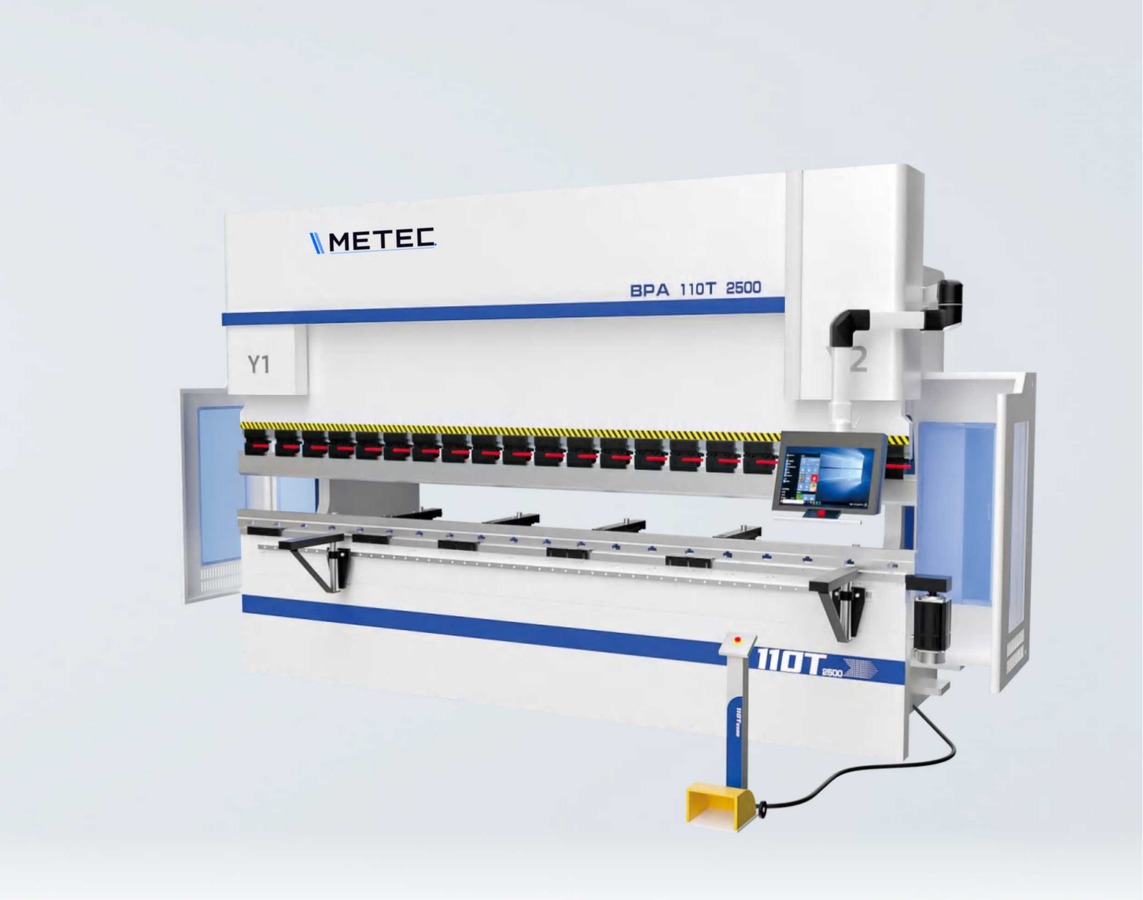
The Y-axes control the vertical movement of the ram. In modern synchronized CNC press brakes, such as the [Metec MPH Series Electro-Hydraulic CNC Press Brake](/products/press-brake/mph-series), the ram is driven by two independent cylinders controlled by closed-loop proportional valves and linear scales.
- Y1 controls the left cylinder.
- Y2 controls the right cylinder.
The X-Axes: Backgauge Depth (X, X1, X2)
The X-axis governs the forward and backward movement (depth) of the backgauge. It is the primary axis responsible for determining your flange length.
- X moves the entire backgauge bar in unison.
- X1 and X2 allow independent depth positioning for the left and right backgauge fingers, essential for bending tapered or asymmetrical flanges.
The R-Axes: Backgauge Height (R, R1, R2)
The R-axis controls the vertical height of the backgauge fingers. This vertical adjustment is vital when you need to clear a previous downward bend to position the part for the next step, or when using dies of different heights in a staged bending setup.
- R moves the backgauge bar up and down as a single unit.
- R1 and R2 provide independent height adjustment for each finger.
The Z-Axes: Lateral Finger Movement (Z1, Z2)
The Z-axes control the left-to-right (lateral) movement of the backgauge fingers along the backgauge bar.
- Z1 and Z2 allow the fingers to automatically adjust their width to support different part sizes or to move into position for different tooling stations along the bed. This is critical for stage-bending operations.
The V-Axis: CNC Crowning Compensation
While not a movement of the ram or backgauge, the V-axis is arguably one of the most important features on machines over 2.5 meters in length. When a press brake applies tonnage, the upper ram and lower bed naturally deflect (bow) in the center. The V-axis is a motorized mechanical crowning system built into the lower table that pushes up the center of the die to counteract this deflection. Without it, long parts will inevitably show angle variations—typically over-bent on the ends and under-bent in the middle.
Comparing Common CNC Press Brake Axis Configurations
Selecting the right configuration is a balance between your current production needs, future versatility, and budget. Here is how the industry categorizes these setups.
2-Axis and 3-Axis: The Basic Workhorses
- 2-Axis (X, Y): This is the most basic CNC configuration, typically featuring a single Y-axis (torsion bar synchronization) and an X-axis backgauge. It is suitable for simple, single-bend parts and thick plate work where precision is less critical.
- 3-Axis (Y1, Y2, X) or (Y, X, V): A true synchronized CNC machine starts here. With Y1/Y2, you gain parallelism control. Adding a V-axis (crowning) makes this setup ideal for straightforward plate bending with automatic deflection compensation. It requires manual height (R) and lateral (Z) adjustments of the backgauge fingers.
4-Axis: The Industry Standard (Y1, Y2, X, R + V)
The 4-axis configuration is the sweet spot for the majority of general fabrication and job shops. By adding the R-axis (vertical backgauge movement), operators can seamlessly execute multi-bend sequences that require different backgauge heights without stopping the machine to make manual adjustments.
For standard bracketry, enclosures, and panels, a 4-axis machine like the [Metec MPS Series Servo Hydraulic Press Brake](/products/press-brake/mps-series) offers excellent efficiency. When combined with a V-axis for crowning (often referred to as a 4+1 setup), it delivers the ±0.01mm precision required for modern manufacturing while keeping capital expenditure manageable.
6-Axis: High-Mix and Stage Bending (Y1, Y2, X, R, Z1, Z2 + V)
The 6-axis configuration adds motorized lateral movement (Z1, Z2) to the backgauge fingers. This setup is highly recommended for shops handling high-mix, low-volume production.
When an operator sets up multiple tool stations across the bed to complete a complex part in one handling (stage bending), the Z-axes automatically move the fingers behind the active tool station. This eliminates the need for the operator to reach into the machine to slide the fingers manually, drastically reducing cycle times and improving safety. If you are processing complex chassis or electrical enclosures, a 6-axis machine is a highly profitable investment.
8-Axis: Maximum Versatility for Complex Geometry (Y1, Y2, X1, X2, R1, R2, Z1, Z2 + V)
An 8-axis configuration provides completely independent control over every aspect of the backgauge. Because X1/X2 and R1/R2 can move independently, the machine can support parts with asymmetrical shapes, tapered flanges, or uneven bend lines.
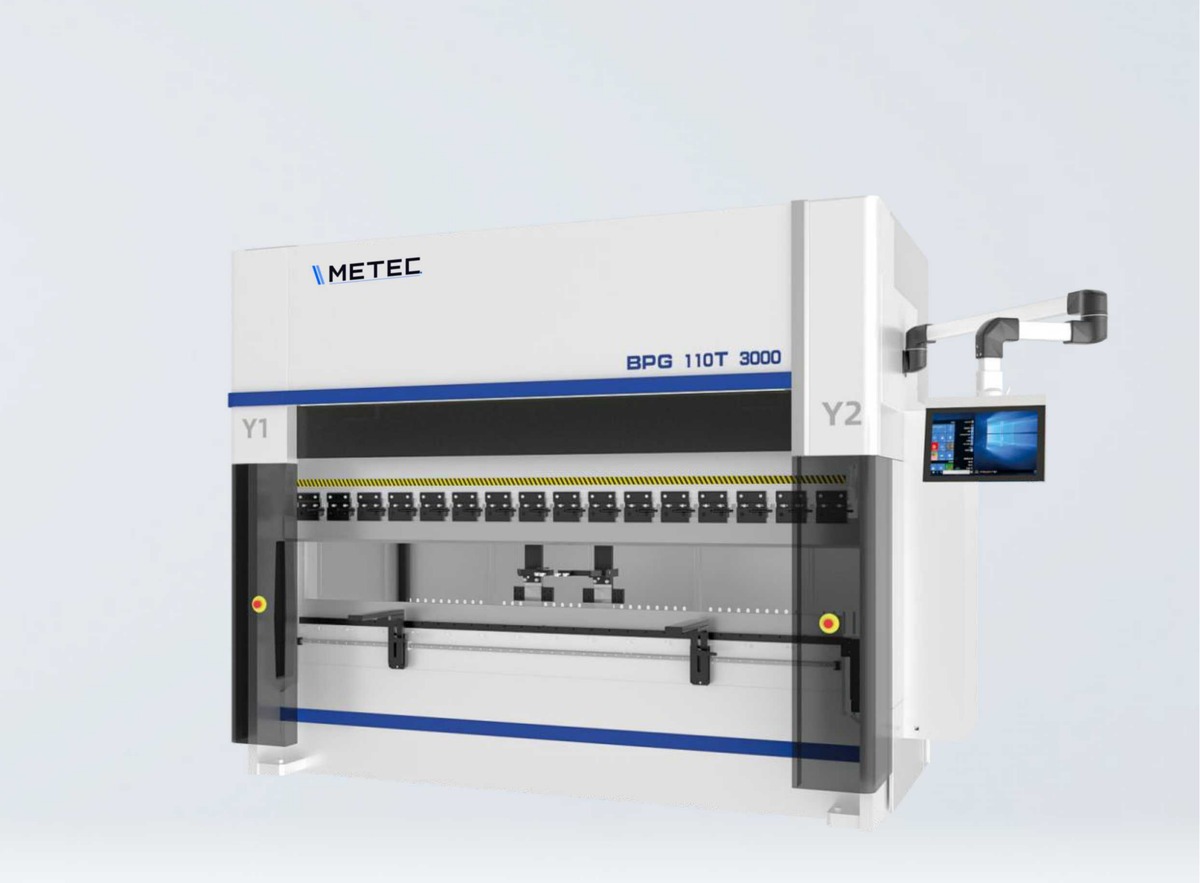
This level of articulation is typically found in high-end [Metec MPG Series Press Brakes](/products/press-brake/mpg-series) used in aerospace, advanced automotive, and specialized architectural fabrication. It requires a robust offline 3D programming software to utilize effectively but offers unparalleled flexibility.
How to Choose the Right Configuration for Your Shop
Investing in more axes than you need ties up capital, while investing in too few limits your growth. Consider the following factors when making your decision:
1. Part Complexity and Mix
Analyze your current and projected product mix. If 80% of your work consists of simple brackets with parallel bends, a 4-axis machine is perfectly adequate. However, if you are bidding on complex enclosures requiring stage bending, a 6-axis setup will pay for itself rapidly in reduced setup and cycle times. If you frequently bend tapered parts, you must invest in independent X1/X2 axes (an 8-axis setup).
2. Operator Skill Level
The manufacturing industry faces a persistent shortage of skilled press brake operators. Multi-axis CNC machines bridge this skill gap. A 6-axis or 8-axis machine, paired with a visual 3D controller, automatically positions the backgauge and guides the operator through the bending sequence. This reduces reliance on the operator's manual measuring and setup skills, ensuring consistent quality regardless of who is running the machine.
3. Quality Assurance and Certifications
Precision is non-negotiable. Ensure that the machine you choose is manufactured to rigorous standards. Metec press brakes are manufactured in an ISO 9001 certified facility and carry CE and SGS certifications, guaranteeing structural integrity and electrical safety. High-quality linear guides and ball screws on the X and R axes are essential to maintain the ±0.01mm positioning accuracy over decades of use.
4. After-Sales Support
A complex multi-axis CNC system requires reliable support. Downtime on a critical bending cell can halt your entire production line. Partner with a manufacturer that offers comprehensive training and 24/7 multilingual support to ensure your team can maximize the capabilities of your multi-axis investment.
Conclusion
The CNC press brake axis configuration you choose will define your fabrication capabilities for the next decade. While a 4-axis machine serves as a robust foundation for general fabrication, the automation provided by 6-axis and 8-axis systems is becoming increasingly necessary to remain competitive in a high-mix manufacturing environment. By carefully evaluating your part geometries and production bottlenecks, you can select a system that delivers precision, reduces setup time, and maximizes your profitability.
Frequently Asked Questions (FAQ)
Q1: What does "4+1 Axis" mean on a press brake specification sheet?
A: "4+1" typically refers to the four main controlled axes (Y1, Y2, X, R) plus the motorized V-axis (CNC crowning). The V-axis compensates for machine deflection but is often counted separately from the ram and backgauge axes.
Q2: Can I upgrade a 4-axis press brake to a 6-axis later?
A: In most cases, no. Upgrading from a 4-axis (manual Z) to a 6-axis (motorized Z1/Z2) backgauge requires entirely different mechanical structures, servo motors, drives, and often a different CNC controller. It is highly recommended to purchase the axis configuration you anticipate needing for the next 5-7 years.
Q3: Why is the R-axis important for bending?
A: The R-axis controls the vertical height of the backgauge fingers. It is essential when a part has a downward-facing flange from a previous bend that would collide with a stationary backgauge. The R-axis automatically raises or lowers the fingers to support the flat portion of the sheet.
Q4: Do I need an 8-axis press brake for standard boxes and pans?
A: No. Standard rectangular boxes and pans with parallel bend lines can be efficiently produced on a 4-axis or 6-axis machine. An 8-axis machine (with independent X1/X2 and R1/R2) is only necessary for asymmetrical parts, tapered flanges, or highly complex geometries.
Q5: How does a multi-axis CNC system improve accuracy?
A: Multi-axis systems utilize precision servo motors, ball screws, and linear guides to position the backgauge with ±0.01mm repeatability. By automating the positioning (X, R, Z), it eliminates the human error associated with manual adjustments and ensures the part is located perfectly for every single bend.
---
Ready to upgrade your bending capabilities with a high-precision multi-axis CNC press brake?
Request a Free Quote from Metec → [metecmt.com/contact](https://www.metecmt.com/contact)
Metec Technical Team
Applications EngineeringThe Metec team brings decades of combined experience in sheet metal processing technology, application engineering, and global manufacturing.